Giving a gift without stuff: is it possible?
A gift without stuff feels bare because of our "unwrapping culture", but research shows that attention and experiences bring more lasting happiness than objects. It works best with a small tangible element (such as a WishBear) that carries the message without the gift being about the object itself.
Carmen Molendijk ·
"A “non-physical gift”, doesn't that feel a bit bare? I have to be able to give “something”, right?" It's a question we hear often. We grew up with the idea that a gift is something you unwrap: a box, paper, a ribbon. But is a physical object really what it's about? We think it's only the form; what matters is the content.
Why we think we need stuff
Giving gifts has traditionally had a physical character. You give something, the other person unwraps it, and a moment of surprise arises. That ritual runs deep in our culture. No wonder a gift with nothing to unwrap feels strange and a bit awkward at first.
But if you look beyond the unwrapping moment, you see something else: what people truly appreciate is not the object itself, but what it stands for! Attention. Time. The feeling of being seen.
What science says about experiences versus stuff
Psychological research on happiness has shown a striking pattern for years: people report more lasting satisfaction from experiences and attention than from physical products. A new object becomes "just a thing you own" after a few weeks. An experience, a memory, or a moment of attention, on the other hand, remains a story you can retell endlessly .
That also explains why gifts such as dinners, days out, or personal messages often make more of an impression than a physical product, and these days the price of such a personal, experience-based gift isn't bad either.
So: is a gift without stuff really okay?
The answer is a clear yes, with one small nuance. A gift without stuff works best when there is still something to hold, see, or reread. Not necessarily to satisfy the "stuff craving", but to give the gift a form that extends the moment.
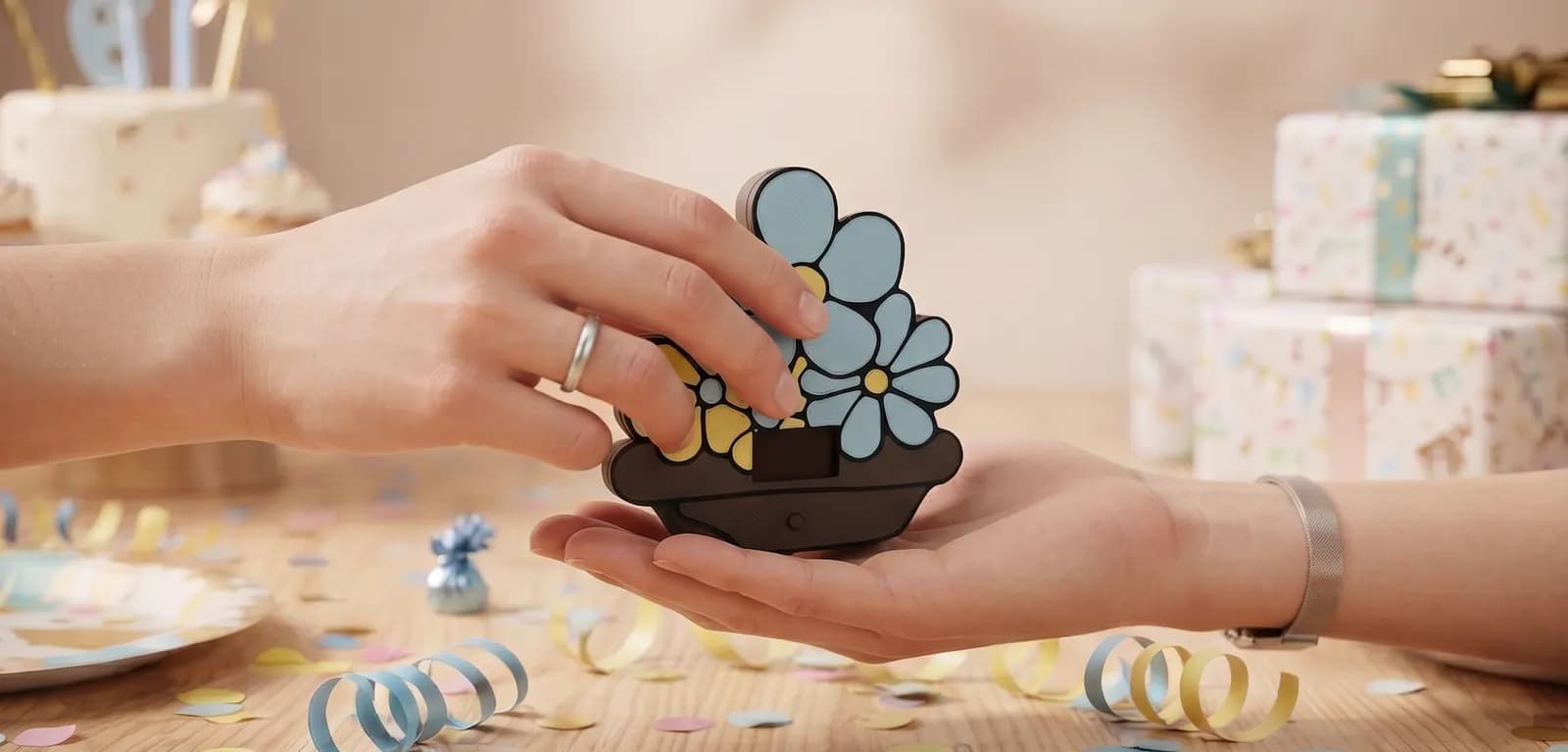
That is exactly the balance a Wishly is after: not a standard product, but a fun, playful object, a WishTree, WishBear or WishFlower, in which your personal wishes are hidden. So the recipient does still unwrap a "thing", but discovers a new message day after day. The gift itself is the attention; the object is merely the way that attention is conveyed.
Three other ways to give a personal gift without stuff:
- Write it out. A letter, a diary, or scattered messages spread over several days give a gift more depth than a single object ever could.
- Make it a moment. An experience, a day together, or time you free up for the other person often weighs more than a physical gift.
- Combine attention with a light form. A small, playful object that carries the message (such as a WishBear) keeps the gift tangible and visible, without it being about the object itself.
So...
A gift without things is not a bare choice, it is a deliberate choice for what truly matters. Want to know how to find a gift nobody else gives? Then read on in "How do you find a unique gift?", where we tell you more about the process of searching for original gifts, because that is no walk in the park either.